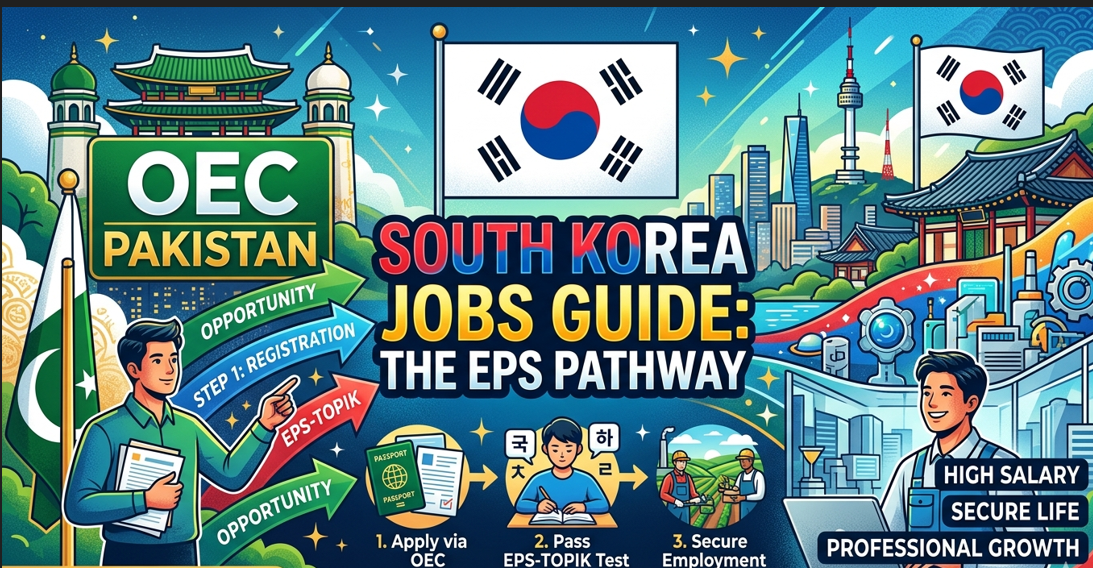
For thousands of Pakistanis, the dream of working in a developed nation with high wages, advanced technology, and a secure environment leads to one primary destination: South Korea. Through a transparent, government-to-government (G2G) agreement, the Overseas Employment Corporation (OEC) facilitates the recruitment of Pakistani workers under the Employment Permit System (EPS).
If you are looking for reliable information on how to secure a job in South Korea, this 2000-word comprehensive guide covers everything from the registration process to life in the “Land of the Morning Calm.”
1. What is the OEC and the South Korean EPS?
The Overseas Employment Corporation (OEC) is the only authorized government body in Pakistan permitted to process labor migration to South Korea. This is done under the Employment Permit System (EPS), a program managed by the South Korean Ministry of Employment and Labor (MOEL) and the Human Resources Development Service of Korea (HRD Korea).
The EPS system was designed to allow Korean small and medium-sized enterprises (SMEs) to hire foreign workers legally when they cannot find local labor. For Pakistanis, this represents a golden opportunity to earn a competitive salary (often exceeding PKR 400,000 to 500,000 per month) in a strictly regulated and safe environment.
2. Why Choose South Korea for Employment?
South Korea has emerged as a top destination for migrant workers for several reasons:
- High Minimum Wage: South Korea consistently increases its minimum wage, ensuring that even entry-level workers earn a substantial income.
- Labor Rights: Unlike some other regions, foreign workers under the EPS are protected by Korean labor laws, including insurance, medical care, and regulated working hours.
- Safety and Infrastructure: Korea is one of the safest countries in the world with world-class public transport and healthcare.
- Skill Development: Working in Korean manufacturing or agriculture exposes workers to advanced technology and disciplined work ethics.
3. Eligibility Criteria for Pakistani Applicants
To apply for a South Korean job via OEC, you must meet the following basic requirements:
- Age: Generally between 18 and 39 years old.
- Education: No specific high-level degree is required, but basic literacy and the ability to learn the Korean language are essential.
- Physical Health: Candidates must be physically fit and pass a medical examination. Color blindness or spinal issues can lead to disqualification.
- Criminal Record: You must have no criminal record or history of illegal stay in South Korea.
- Travel Restrictions: You must not be barred from leaving Pakistan.
4. The Step-by-Step Application Process
The journey to South Korea is a marathon, not a sprint. Here is the breakdown of the OEC process:
Step 1: Pre-Registration and Balloting
Due to the massive number of applicants, OEC often conducts a “Balloting” process. You register your interest on the OEC website, and a computer-generated draw selects the candidates who can proceed to the next stage.
Step 2: The EPS-TOPIK Exam
This is the most critical hurdle. The Test of Proficiency in Korean (TOPIK) evaluates your reading and listening skills in the Korean language.
- Reading (20 questions): Tests vocabulary and grammar.
- Listening (20 questions): Tests comprehension of spoken Korean.
Step 3: The Skill Test
Those who pass the language exam move to the Skill Test. This involves:
- Physical Strength: Grip strength and back strength.
- Basic Skills: Task-based assessments (e.g., sorting items, assembling simple parts).
- Interview: A basic conversation in Korean to check your communication ability.
Step 4: Job Application and Job Seekers’ Roster
Once you pass both tests, your data is uploaded to the HRD Korea roster. From here, Korean employers browse the profiles and select workers based on their needs. Passing the test does not guarantee a job; it makes you eligible to be selected by an employer.
Step 5: Issuance of Visa (E-9)
If an employer selects you, they issue a Standard Labor Contract (SLC). OEC then coordinates the visa processing (E-9 Non-professional employment visa) and pre-departure briefing.
5. Understanding the Work Categories
Most Pakistani workers in South Korea are employed in the following sectors:
- Manufacturing: The most popular sector. Jobs include working in plastics, rubber, metal fabrication, and textile factories.
- Agriculture/Livestock: Working on farms, greenhouses, or cattle ranches.
- Construction: Heavy labor involving building infrastructure.
- Fisheries: Working on fishing boats or in seafood processing plants.
6. Financial Costs and Transparency
One of the best parts of the OEC South Korea program is its transparency. Since it is a government agreement, there are no “hidden fees” or “agents” involved.
- Test Fees: Usually around $24–$28 (paid in PKR).
- Medical & Protection: Direct costs for insurance and medical checkups.
- Ticket & Visa: The candidate usually bears the cost of the air ticket and visa processing.
Warning: Never pay money to private agents promising “guaranteed” Korean visas. Only the OEC is authorized to handle this process.
7. Life in South Korea for Pakistanis
Culture and Language
The “Hallyu” (Korean Wave) has made Korean culture famous worldwide. However, working there is different from watching dramas. Koreans value Pali-Pali (Hurry-Hurry) culture—meaning they expect high efficiency and hard work. Learning the language is not just for the exam; it is your survival tool for communicating with your “Sajang-nim” (Boss).
Food and Halal Availability
While South Korea is a meat-loving country, Halal food is becoming more accessible. There are many Pakistani and Indian restaurants in cities like Seoul, Ansan, and Gimhae. Most factories provide food; you can request “No Pork” (Dwaeji-gogi ppae-juseyo) or cook your own meals in the dormitory.
Religious Life
South Korea is very respectful of religious freedom. There are several mosques (Masjids) across the country, including the famous Seoul Central Mosque in Itaewon. Many workers find small communities of fellow Pakistanis to celebrate Eid and other festivals.
8. Financial Management and Remittances
A worker in South Korea can save a significant portion of their salary.
- Salary: Avg. 2,010,000 KRW (Minimum wage as of 2024).
- Overtime: Working on Saturdays or extra hours can significantly boost income.
- Savings: By living frugally in company dormitories, many workers send back PKR 200,000 to 300,000 monthly.
9. Tips to Clear the EPS-TOPIK Exam
Since the competition is fierce, your score in the TOPIK exam determines your rank.
- Join a Language Center: Many institutes in Pakistan specialize in EPS-TOPIK training.
- Use Mobile Apps: Use apps like “EPS TOPIK CBT” to practice previous papers.
- Vocabulary is King: Memorize the 2,000 standard words provided by HRD Korea.
- Listen Daily: Watch Korean news or listen to podcasts to tune your ears to the accent.
10. Returning Home: The “Happy Return” Program
The EPS system isn’t just about sending you away; it’s about bringing you back with skills. HRD Korea offers the Happy Return Program, which provides:
- Vocational training for jobs back in Pakistan.
- Support for starting a business.
- Recruitment services for Korean companies operating in Pakistan (like Samsung, Lucky-Motor, etc.).
11. Frequently Asked Questions (FAQs)
Q1: Can I take my family to South Korea on an E-9 Visa? No. The E-9 visa is for the worker only. You cannot sponsor family members on this specific visa category.
Q2: How long is the work contract? The initial contract is for 4 years and 10 months. If you are a “Sincere Worker” (don’t change your workplace), you may be eligible to return for another term.
Q3: What happens if I lose my job? If a factory closes or there are issues, you are allowed a certain number of workplace changes under the EPS rules, but you must find a new employer within a specific timeframe.
Q4: Is the OEC the only way to go to Korea? For labor/technical jobs (E-9), yes. For professional jobs (E-7) or studies (D-2), there are different pathways, but for the general public, OEC is the primary route.
12. Conclusion
Working in South Korea via the OEC is a life-changing opportunity for Pakistani youth. It provides a path to financial stability, professional growth, and a chance to experience one of the world’s most vibrant cultures.
The key to success lies in patience and preparation. Don’t wait for the OEC advertisement to start learning Korean. Start today, stay focused on the official OEC website (oec.gov.pk), and prepare yourself for a bright future in the Land of the Morning Calm.


Leave a Reply