In the fast-paced world of digital communication, language moves quicker than ever. Words are shortened, letters are swapped, and meanings are layered until a single syllable carries the weight of an entire lifestyle. Enter: Rabe.
Whether you’ve seen it in a TikTok caption, heard it in a Berlin basement, or stumbled upon it in a Spanish-language group chat, “Rabe” is a fascinating case study in how humans adapt language to fit their environment.
1. What is “Rabe”? Defining the Core Slang
At its most basic level, Rabe (pronounced rah-beh or ray-be) is a slang variation of the word Rave.
In the context of 2026 youth culture, “Rabe” refers to an underground electronic dance music party, typically involving techno, house, or drum and bass. However, it isn’t just a typo for “Rave.” It represents a specific sub-aesthetic.
- The Phonetic Swap: In many languages, specifically Spanish and some Eastern European dialects, the “V” and “B” sounds are nearly identical (bilabial fricatives).
- The Digital Identity: Using “Rabe” instead of “Rave” acts as a digital “handshake.” It signals that the user is part of an “in-the-know” crowd that prefers the gritty, underground side of the music scene over the commercial EDM festivals.
2. The Etymology of “Rabe”: Where Did It Come From?
To understand why “Rabe” has staying power, we have to look at its three primary roots:
A. The Spanish “Betacism” influence
In Spanish, the letters “b” and “v” are pronounced the same in many contexts. As global music culture becomes more integrated—with Latin Tech-House and “Guaracha” exploding in popularity—the spelling “Rabe” began appearing in invitations and social media posts from South America and Spain. This “Betacism” (the confusion of B and V) was adopted by English speakers as a “cool” or “exotic” way to rebrand the tired concept of a rave.
B. The German “Raven” (The Bird)
In German, “Rabe” means Raven. The raven has long been a symbol of the dark, the mysterious, and the nocturnal. Because the “Rave” scene is inherently nocturnal, German subcultures began using the word “Rabe” as a double entendre. To go “Rabe-ing” was to go out into the night like a bird of prey, seeking the dark energy of the warehouse party.
C. The “Phonk” and “Hardstyle” Typo Trend
Online “troll” culture and “shitposting” often involve intentional misspellings to mock mainstream trends. By 2024 and 2025, calling a party a “Rabe” became a way to signal irony. It’s the linguistic equivalent of wearing “ironic” fast-fashion—it’s so wrong that it’s right.
3. Rabe vs. Rave: What’s the Difference?
While they share a root, the connotations have diverged.
| Feature | Rave (Standard) | Rabe (Slang/Underground) |
| Location | Stadiums, Festivals (Coachella, Tomorrowland) | Warehouses, Forests, Basements |
| Vibe | Neon, PLUR (Peace, Love, Unity, Respect) | Industrial, Black clothing, High-BPM |
| Music | Mainstage EDM, Pop-Remixes | Hard Techno, Acid, Gabber, Phonk |
| Visuals | LED screens, Pyrotechnics | Strobe lights, Smoke machines, Minimalism |
4. The “Rabe” Lifestyle: Fashion and Aesthetics
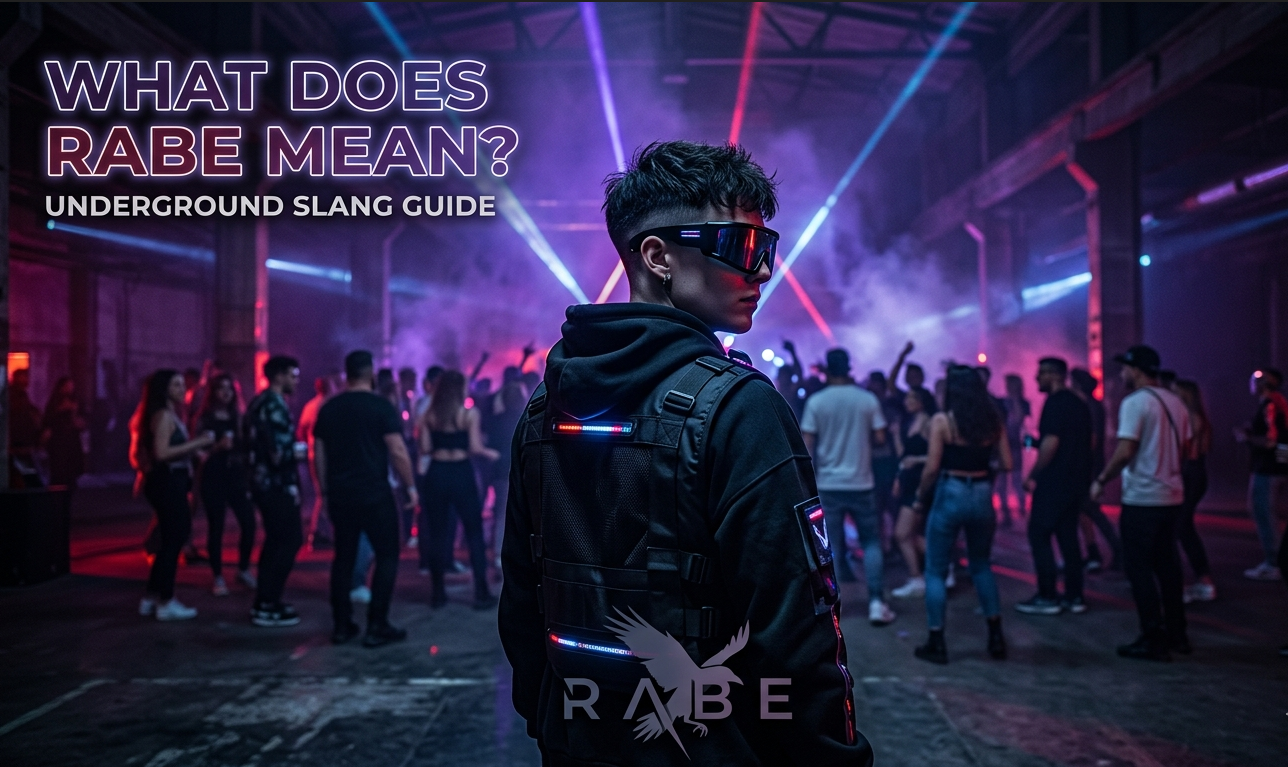
If you are “going to a Rabe,” you aren’t dressing for a standard party. The “Rabe” aesthetic is heavily influenced by Cyberpunk and Gorpcore.
- The Color Palette: Almost exclusively black, charcoal, and deep “raven” purple.
- The Materials: Technical fabrics (nylon, gore-tex) mixed with DIY elements like safety pins and oversized chains.
- The Accessory: Speed glasses (wraparound sunglasses) are mandatory, even at 3:00 AM in a dark room.
This look is often referred to in SEO circles as the “Techno-Viking“ or “Berlin-Core” aesthetic. By using the keyword “Rabe,” brands and influencers can target a very specific demographic that values utility and darkness over the “glitter and rainbows” of traditional rave culture.
5. How to Use “Rabe” in a Sentence (Contextual Examples)
To master the slang, you must understand the syntax. “Rabe” can be used as a noun or a verb.
- As a Noun: “The Rabe last night was insane; the bass was vibrating my soul.”
- As a Verb: “Are we Rabe-ing this weekend, or are we staying in?”
- As a Descriptor: “That track is so Rabe—it’s got that dark, industrial crunch.”
6. Deep Research: The Psychology of Slang Evolution
Why do we change “Rave” to “Rabe”? Linguists call this Social Signaling.
When a word becomes too popular (like “Rave”), it loses its “cool” factor. The mainstream begins to associate “Rave” with teenagers in neon tutus. To protect the “sacred” underground space, the original community changes the language.
By using “Rabe,” the community creates a filter. If you search for #Rave on Instagram, you see millions of generic posts. If you search #Rabe, you find the actual underground. This is a form of Digital Gatekeeping that keeps the subculture alive.
7. SEO Strategy: Why This Keyword Matters for 2026
If you are a content creator or a marketer, “Rabe” is a “Long-Tail Keyword” goldmine.
Why it works for SEO:
- Low Competition: Everyone is fighting for the word “Rave.” Almost no one is optimizing for “Rabe.”
- High Intent: People searching for “Rabe slang meaning” are usually Gen Z or Alpha users who are highly active on social media and have high purchasing power in the fashion/music niches.
- Cross-Platform Synergy: Because “Rabe” is a “misspelling,” it captures “fat-finger” search traffic (people who accidentally hit ‘B’ instead of ‘V’) while also capturing the intentional slang users.
8. The Global Reach of “Rabe”
The term isn’t limited to one country. It has become a global phenomenon:
- In Eastern Europe: Linked to the “Hardbass” movement.
- In the UK: Influenced by the “Chav” and “Roadman” dialects where “B” sounds are often emphasized.
- In the US: Popularized by TikTok “Alternative” niches (Alt-Tok).
9. Conclusion: Is “Rabe” Here to Stay?
Slang is often fleeting, but “Rabe” has the benefit of being rooted in several major languages and a massive global music scene. As the “darker” side of electronic music continues to dominate the charts in 2026, the term “Rabe” will likely solidify its place in the urban dictionary.
It’s more than just a word; it’s a symbol of the night, a nod to the underground, and a testament to how the internet reshapes our tongues.



Leave a Reply